
close

Trainer

Trainer

Winter Potty Training: How to Get a Stubborn Puppy to Pee in the Snow

Stepping out into a biting January wind at six in the morning is miserable enough on its own. It becomes an exercise in pure exasperation when you are standing in a snowbank in your slippers, pleading with an eight-pound puppy who has anchored all four paws to the welcome mat and refuses to budge. You wait ten freezing minutes while your puppy shivers violently, stares at you with absolute betrayal, and accomplishes nothing. The moment you give up and step back into the warm house, your puppy trots straight to the living room rug and relieves themselves without hesitation.
Winter potty training is notorious among dog owners for a reason. While spring and summer litters have the luxury of soft green grass, warm sunshine, and leisurely outdoor exploration, winter puppies face an uphill battle against the elements. When a young dog balks at snow, they are rarely acting out of spite or stubbornness. To a puppy, winter represents acute sensory shock, physical discomfort, and genuine instinctual vulnerability.
Transforming those icy standoffs into swift, reliable outdoor bathroom breaks requires shifting your approach from patience alone to structured preparation, physical protection, and targeted incentives.

Understanding the Winter Resistance: Why Puppies Balk at Snow

Before you can fix the behavior, you have to understand what happens to a young dog when they encounter freezing weather. Puppies possess minimal body fat, thin coats, and bellies that sit just inches above the ground. Plunging into a drift of snow is the human equivalent of wading naked through an ice bath.

The Physical Reflex of Cold Ground

Urination and defecation require a dog to relax specific muscle groups. When sub-zero temperatures hit a puppy’s bare paws and icy slush splashes against their underside, their nervous system triggers an involuntary physical reaction: muscles contract, the body shivers to generate heat, and the posture tightens. The physiological relaxation necessary to eliminate becomes nearly impossible while the puppy is locked in a full-body clench.

Disappearing Scent Markers

Canine elimination is heavily scent-driven. Dogs rely on lingering scent cues from previous outings, soil, and decomposing vegetation to trigger the urge to go. A fresh blanket of snow seals away those familiar odors under several inches of frozen insulation. For a young dog whose routine is still fragile, an odorless white blanket looks, feels, and smells like an entirely foreign environment where they do not yet know how to behave.

Sensory Overload and Fear

Snow transforms the acoustics and visuals of your yard. Familiar objects disappear, sounds are muffled, and wind creates sudden, alarming gusts. Depending on your puppy’s temperament, deep snow either triggers intense panic or sudden, frantic overstimulation. Some pups freeze in place out of fear, while others turn into manic snow-plows, biting at snowflakes and tunneling through drifts, completely forgetting the biological urge that brought them outdoors in the first place.

Preparing the Yard: Creating a Winter Elimination Zone

Expecting a tiny puppy to trudge through deep snow to find a spot on their own is setting them up to fail. Your first job as a winter puppy parent is physical landscaping.
Shovel down to the bare earth. Clear a wide pathway from your exit door leading directly to a dedicated relief station. Shovel out a flat square roughly four feet by four feet, clearing away the snow completely until you reach frozen grass, dirt, or pavement. This provides your puppy with stable, flat footing where cold snow is not actively pressing into their belly or tail.
Choose a sheltered perimeter. Wind chill is often a greater deterrent than ground temperature. Establish your puppy’s winter relief area in the most sheltered corner of your property, such as against a tall privacy fence, alongside an exterior brick wall, or behind an evergreen windbreak. Blocking the direct sweep of freezing wind keeps your puppy focused and prevents panic.
Insulate the ground surface. Frozen ground leeches warmth from small paw pads within seconds. To make the cleared area inviting, spread an insulating layer over the bare dirt or ice. A light layer of clean straw, untreated wood shavings, or even a spare piece of artificial turf provides thermal separation between your pup’s feet and the frozen earth. The familiar texture of straw or turf also helps reactivate their elimination instincts.

Equipping Your Puppy for Sub-Zero Trips

Proper winter gear is not about vanity or dressing up your pet; it is functional equipment that keeps their nervous system calm enough to do business.

Core Warmth

A small, single-coated, or short-legged puppy loses body heat rapidly. Invest in a well-fitted, fleece-lined jacket or sweater that wraps snugly around the chest and torso. The jacket must have a high-cut belly line so that it stays dry when the puppy squats or lifts a leg. Wet fabric against bare skin accelerates chilling and will make the next outdoor trip twice as difficult. Put the coat on your puppy a minute or two before opening the door so their core is already warm when the cold air hits.

Paw Protection and Salt Safety

Snow easily packs between delicate toes, forming hard ice balls that stretch the paw pads and cause sharp pain. Furthermore, urban and suburban sidewalks are often coated in chemical de-icers and coarse rock salt that can burn tender footpads.
  • Apply a dense, food-grade paw protection wax to your puppy’s pads before heading out. Wax creates a semi-permeable shield that repels moisture, stops snowballs from sticking to paw hair, and protects against drying salt.
  • If your puppy tolerates footwear, lightweight rubber booties offer complete moisture protection. However, do not introduce booties for the first time during an urgent potty break. Practice wearing them indoors with treats first so your puppy does not freeze in place trying to kick them off in the yard.
  • Keep a clean, damp towel by the entryway. The second you step inside, wipe down your puppy’s paws to remove snow, road salt, and dirt. This prevents stinging and ensures they do not ingest toxic chemical melts by licking their paws clean.

The Winter Potty Protocol: Step by Step

Consistency is the backbone of housebreaking, but winter demands speed and precision. Lengthy, casual sniff-walks are counterproductive in freezing weather.

1. Carry, Do Not Walk

When taking a puppy out in deep winter, pick them up and carry them through the doorway and straight to their designated shoveled relief patch. If you allow a small puppy to walk the whole way, they will waste their brief threshold of tolerance stumbling through drifts, shivering, or trying to turn back toward the warm house. Placing them directly into the target zone conserves their energy and immediately frames the purpose of the trip.

2. Keep Them on a Short Leash

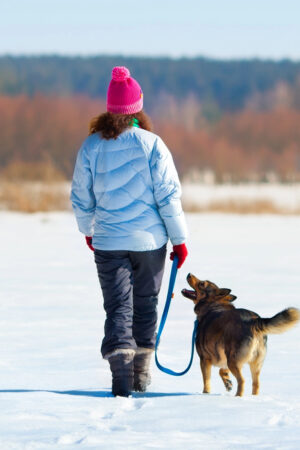
Never let a winter puppy loose in the yard to roam freely. An off-leash puppy will either sprint back to the door or get lost in snowdrifts and lose focus. A standard four-to-six-foot leash keeps your pup centered on the shoveled patch, restricts wandering, and establishes that outdoor trips are purely business. Stand calmly in the center of the patch and let the puppy move in a small circle around you.

3. The Strict Four-Minute Window

Set a strict timer in your head: three to four minutes maximum. If your puppy has not gone within that window, keeping them outside longer will only cause escalating misery and negative associations with cold weather.
If they do not go, calmly pick them up and bring them inside. Do not grant them immediate house freedom. Place them directly into their crate, a playpen, or tether them to your waist via an umbilical leash for ten to fifteen minutes. During this holding period, their bladder remains full, but supervision prevents an accident. Once the holding period is up, carry them straight back out to the cleared patch and try again. Repeat this cycle until they eliminate outside.

4. Deploy High-Value Jackpot Rewards

Standard kibble is rarely enticing enough to overcome the discomfort of freezing temperatures. When training in winter, you must bring out top-tier incentives. Keep moist, aromatic, high-protein treats in a coat pocket where your body heat keeps them warm and fragrant. Small slivers of plain roast chicken, freeze-dried liver, or hot dog work exceptionally well.
The exact second your puppy finishes eliminating, deliver enthusiastic praise and a succession of three to four high-value treats directly to their mouth. Deliver the reward while your puppy is still standing in the snow. If you wait until you walk back inside, your puppy will associate the treat with entering the house rather than relieving themselves in the cold.

Handling Extreme Weather and Common Setbacks

Even the most dedicated training plan runs into complications when severe winter storms, blizzards, or sub-zero polar vortexes arrive.

Navigating Hazardous Wind Chills

When temperatures drop into single digits or sub-zero wind chills, young puppies face a real risk of hypothermia and frostbite within minutes. During severe winter weather advisories, prioritize safety over outdoor perfection.
Set up a temporary indoor transition station in an unheated porch, attached garage, or utility room. Lay down a plastic tarp topped with a tray of fresh sod or clean straw. This keeps the sensory experience of natural substrate intact without exposing a vulnerable puppy to life-threatening wind chills. Once the severe cold front breaks, transition immediately back to your outdoor shoveled zone.

Breaking the Indoor Relief Habit

If your puppy develops a habit of immediately peeing on the rug after coming inside, you are likely leaving the outdoor zone too quickly or missing subtle pre-potty signals. When you return inside after an unsuccessful attempt, do not set the puppy down on carpeting or rugs. Hold them or keep them on a non-porous floor like tile or laminate where you can watch their body language. The moment they drop their tail, circle, or sniff intently, scoop them up mid-motion with a cheerful interruption and head back outside.
Clean every indoor accident thoroughly with a dedicated enzymatic cleaner. Standard household detergents remove visible stains but leave behind microscopic uric acid salts that signal to your puppy that the carpet is an approved indoor bathroom.

Raising a Weatherproof Companion

Winter housebreaking tests the stamina of every dog owner. It requires shivering through dark mornings, shoveling snow paths at midnight, and maintaining discipline when curling up under a warm blanket sounds far more appealing.
Yet there is a distinct silver lining to winter litters. Dogs raised to potty reliably in snow, ice, and biting winds rarely develop the weather sensitivity that plagues dogs raised in mild climates. By protecting your puppy’s physical comfort, clearing their path, and making success unmistakably rewarding, you teach them that winter is manageable. With a week or two of clear, structured execution, your puppy will learn to step outside, finish their business promptly, and trot back inside to the warmth with pride.
read more
DogTrainer

The Counter-Surfing Cure: Training Your Dog to Ignore Kitchen Prep

You turn your back for four seconds to grab the olive oil from the pantry, and the trimmed chicken breast resting on your cutting board vanishes. In its place stands an eighty-pound retriever licking his chops, looking up with an expression of pure, unbothered innocence. Or perhaps your dog is smaller, launching onto their hind legs like a spring-loaded jack-in-the-box the moment a package of cheese crinkles.
Counter-surfing is one of the most maddening habits a pet parent can deal with. It turns weeknight meal preparation into an exhausting game of defensive culinary hockey. You chop onions with one hand while physically blocking the kitchen perimeter with your hip, constantly bracing for the next raid. Worse still, it is dangerous. Between sharp kitchen knives, smoking cast iron skillets, and toxic ingredients like onions, garlic, and chocolate, a dog with vertical ambitions can cause serious harm to themselves in an instant.
Yelling “Off!” after the fact rarely does a thing. Banishing this habit permanently requires understanding the canine brain, eliminating accidental rewards, and teaching an alternative behavior so reliable that your dog chooses their own bed over your kitchen island.

The Anatomy of Counter-Surfing: Why Scolding Fails

Most dog owners tackle counter-surfing with verbal reprimands. You catch your dog with two paws on the granite, clap your hands, shout “No,” and push them off. To a human, that interaction communicates disapproval. To a dog, you have just engaged in a thrilling game of physical tag, or at the very least, rewarded them with direct eye contact and vocal attention.
To fix this behavior, you have to look at the kitchen through the eyes of an opportunistic scavenger.

The Power of Intermittent Reinforcement

In the dog world, counter-surfing is the canine equivalent of a Las Vegas slot machine. A dog might jump up twenty times and find nothing more than a clean sponge or a dry dish towel. But on the twenty-first jump, they hit the jackpot: an unattended stick of butter or a slice of warm sourdough bread.
In behavioral psychology, this is known as a variable schedule of reinforcement. When a behavior produces an unpredictable, high-value payout, that behavior becomes extraordinarily resistant to extinction. Your dog does not care that they struck out twenty times yesterday. They will happily jump thirty times today because the memory of that one stick of butter never fades.

The Flaw of Delayed Correction

Dogs operate strictly in cause-and-effect windows measured in split seconds. If your dog grabs a strip of bacon off the counter, eats it, and you yell at them four seconds later as they swallow, the correction is functionally useless. In your mind, you are punishing the theft. In the dog’s mind, they were rewarded with delicious pork, and now their human is acting erratic for no apparent reason. The food has already reinforced the jump, rendering any subsequent scolding entirely meaningless.

Phase One: Bulletproof Environmental Management

You cannot train a dog out of a self-rewarding behavior while continuing to give them opportunities to practice it. Every single time your dog succeeds in swiping a crumb from the counter, your training resets to zero. Before you pick up a clicker or a treat pouch, you must enforce total environmental lockdown.
The clear-counter standard. Kitchen surfaces must be kept entirely barren when not in active use. This means no cooling cookies sitting under plastic wrap, no butter dishes on the island, and no bread bags left on the perimeter. If food must thaw, thaw it inside the microwave, the refrigerator, or an upper cabinet. Wipe down counters immediately after cooking to remove aromatic cooking grease that encourages scent-driven investigations.
Physical barriers. During the initial weeks of training, your dog should not have unmonitored access to the kitchen. Use freestanding baby gates, tension gates, or closed pocket doors to block entryways. If you have an open-concept floor plan that resists gating, use a designated exercise pen or keep your dog tethered to your waist on a hands-free leash when you are not actively working on training drills.
Management is not a cop-out; it is the scaffolding that allows new habits to take root. If your dog cannot physically reach the counters, they stop checking the counters.

Teaching the Incompatible Behavior: The “Place” Command

You cannot simply tell a dog what not to do. Nature abhors an instructional vacuum. If you take away counter-surfing, you must provide a concrete, highly rewarded job to replace it. The most effective antidote to kitchen chaos is teaching a rock-solid place command.
The premise is straightforward: your dog cannot have their paws on the kitchen counter if their entire body is lying flat on an orthopedic dog bed across the room.

Selecting and Positioning the Station

Choose a dedicated mat, cot, or flat dog bed with clear visual and physical edges. Raised elevated beds work exceptionally well because the physical drop-off at the edge gives the dog clear tactile feedback about their boundaries.
Position this bed outside the immediate kitchen footprint, but keep it within the dog’s line of sight. Dogs surf counters partly for food, but also partly because the kitchen is the operational hub of the house. If you banish your dog to a distant laundry room, they will fight to rejoin the action. Placing their mat six to ten feet away allows them to watch the dinner theater without being in your way.

Building Duration and Value

Do not expect your dog to hold this position while you roast a Thanksgiving turkey on day one. You must build duration gradually, away from mealtime distractions.
Lure your dog onto the bed, cue “Place,” and mark the exact moment all four paws settle on the fabric with a crisp verbal marker like “Yes” or a clicker. Immediately deliver a high-value treat between their front paws.
Keep your treat delivery low to the surface of the mat; you want the mat itself to feel like a magnet. Release them with a cheerful break word like “Free” and toss a piece of kibble away from the bed.
Gradually stretch the duration: five seconds, ten seconds, thirty seconds, two minutes. The rule of thumb during this phase is simple: deliver the reward to the dog on the mat, never call the dog off the mat to receive food. The bed is where all good things happen.

Proofing in the Danger Zone: The Kitchen Ladder

Once your dog understands that the mat is a high-yield zone during quiet training sessions, you must systematically introduce kitchen-specific triggers. Think of this as climbing a ladder, starting with low-arousal prep work and culminating in full-course dinner preparation.

Step 1: Low-Aroma Cold Prep

Equip yourself with a training pouch filled with bite-sized pieces of boiled chicken or string cheese. Send your dog to their place mat.
Walk over to your cutting board and perform a low-value task: wash an apple, slice a cucumber, or tear lettuce. Turn around, walk directly to their bed, and feed them. Return to your cutting board, chop another vegetable, and return to feed them again.
You are teaching your dog an unexpected pattern: your work at the kitchen counter predicts treats appearing on their bed, not from the kitchen edge. Keep these initial sessions under five minutes.

Step 2: The Sound and Motion Triggers

Dogs often respond to auditory cues before they ever catch a scent. The crackle of plastic deli wrappers, the thud of a butcher knife on wood, or the opening of the refrigerator door are classic action cues that send dogs sprinting into the kitchen.
With your dog stationed on their place mat, simulate these noises:
  • Open and close the refrigerator door, then immediately reward on the mat.
  • Rattle a plastic bag, then immediately reward on the mat.
  • Bang a stainless steel pot lightly on the stove, then reward on the mat.
If your dog breaks position and runs toward you, remain calm. Do not scold them. Simply close the pantry or set down the utensil, step into the dog’s space with your body, and calmly guide them back to their station using their collar or a light leash. Reset the drill, take one step backward in difficulty, and try again.

Step 3: High-Scent Cooking

The ultimate test of impulse control involves cooking actual proteins. Sizzling ground beef, frying bacon, or searing fish will flood your home with irresistible scents that challenge your dog’s self-control.
During the first several high-scent dinners, give your dog a long-lasting, focused project on their mat rather than relying entirely on sporadic treats. A frozen rubber toy stuffed with canned meat, peanut butter, and Greek yogurt can occupy a dog for thirty to forty-five minutes.
By pairing the smell of active cooking with an intense, licking-focused activity on their designated bed, you build an automatic associative response: when food is cooking on the stove, my job is to settle on my bed and work on my own puzzle.

The “Oops” Protocol: Handling Dropped Food

Every cook drops food eventually. A slippery piece of raw meat falls from the counter, bounces off your foot, and lands squarely on the tile floor. In an untrained household, this triggers a desperate, chaotic race between human hands and canine teeth.
To keep your kitchen safe, you must establish an absolute rule: dropped food is never fair game.
Practice intentional drop drills outside of actual cooking sessions. With your dog sitting on a leash a few feet away, hold a low-value piece of food, like a baby carrot or a slice of bell pepper. Drop it onto the floor while giving a firm “Leave it” cue.
Cover the dropped food with the sole of your shoe if the dog lunges toward it. The second your dog pulls their nose back and looks up at your face, mark the eye contact and deliver a completely different, much tastier treat from your hand or pouch.
With repetition, your dog learns that ignoring floor spills leads to a superior reward. When an accidental drop happens during actual meal prep, your dog will hesitate and look to you for guidance rather than diving headfirst beneath your feet.

Consistency Across the Household

The greatest enemy of counter-training is inconsistency. If one family member strictly enforces the boundary while another sneakily feeds the dog scraps from the prep board, your training will stall. Dogs are masters of discrimination; they will quickly learn which humans allow counter-grazing and which do not.
Convene a quick family meeting and establish ground rules:
  • No food is ever given directly from the cutting board, counter, or dining table.
  • All kitchen rewards must travel from your hand to the dog’s mat or bowl.
  • If someone is unable to supervise during meal prep, the dog must be placed behind a gate or in their crate with a chew.
Overcoming counter-surfing is rarely a matter of weeks; it is a gradual rewiring of an ancient predatory instinct. But when you replace aimless scolding with strict management, clear boundaries, and valuable alternative jobs, your kitchen changes completely. You get to chop, simmer, and bake in absolute peace, knowing your food is safe and your dog is resting happily in their own lane.
read more
Trainer

Characteristics of the Good Dog Trainer – Essential For any Dog

Each time a pet is introduced by they’re trained to enable them to behave inside a correct way. Initially all of the pets were trained through the masters but nowadays professional trainers came up. These trainers are very well qualified and train pets. It requires hard deal with persistence. So it’s needed that you employ a qualified trainer which is the best for your dog.

All trainers aren’t good. Prior to hiring them you must understand about how exactly much experience they’ve. A skilled trainer is generally preferred more than a fresher because he knows better how you can train your pet. The trainer must have the ability to set up a good reference to your pet. The easiest method to cope with them is as simple as understanding their nature as well as their liking.

The top factor to understand is your pet should be confident with the trainer. You may also attend some sessions using the dog so you are aware the way your pet is treated. It is crucial that certain will get the very best trainer for his or her dogs. You are able to let them know about a number of your dog’s habit causing them to be straightforward. It’s very necessary they have a great tuning among themselves. This can facilitate to operate more easily.

Working out of various pets differs. Whether or not they are cats or dogs all require a training. A great trainer is a that can find out the problems and connect them correctly. You ought to be aware of the characteristics from the trainer and how long he devotes using the pets.

If still you cannot find the best trainer searching those sites and for training schools. They’re many training schools opened up for that pets. You pay some charges for that training. So you’ll want detailed information before investing into may be. You can also talk to your neighbors who’ve provided training for their pets. Even you are able to interview many people for your.

So that it becomes necessary for find the best trainer because without one your dog won’t be trained. Locating a trainer is much like you do searching for your dog. It’s the duty from the master to supply a good training to ensure that their pet behaves in an easy method.

read more
Trainer

Beginning With Pet Training

Most pet proprietors find it hard to train their dogs. Some breeds are simpler to coach, however, many can be quite persistent. Additionally, it depends upon the objective of training. Teaching fundamental behavior training could be a little simpler, when compared with harder instructions, or maybe practicing agility competition and dog sports.

While there are plenty of pet trainers and canine training schools, availing their professional services may need proprietors to stretch their budget and spend some extra. For this reason many of them are searching for convenient, easy, and cost-effective way to train their pets.

The least expensive method of course, would be to perform the training yourself. You need to simply devote some of your energy, a great deal of effort and persistence. Training your pet personally will usually increase dog-owner relationship. It enables someone to bond together with his dog, educate him the instructions he want, and then commend your pet for his behavior training.

Training could be demanding particularly if it’s both owner and also the dog’s very first time. So what you can do to create things simpler? First, attempt to find out about pet training. This enables you to know what to anticipate. Additionally, it provides you with a concept of the dos and also the don’ts. Second, talk to professionals or perhaps your buddies who’ve effectively trained their dogs. This can be done by delivering email from trainers, or entering pet forums in which you are able to discuss pet problems and seek training tips from vets, to trainers, as well as using their company proprietors as if you.

Third, you shouldn’t be afraid to test individuals canine training aids. These items are pet safe which means you will not have to bother about pet safety and health. These were designed to ease dog proprietors of coaching problems and extra expenses. You should consider asking within the forums what brands or models they are able to recommend. Solutions ranges from Petsafe, to Innotek, to Dogtra, and etc. Many of these products can definitely deliver fast and effective training.

Using these tips about how to start pet training, proprietors now get sound advice first, where you can make inquiries, and the way to make training simpler, but nonetheless gaining good results.

read more
Trainer

How you can Train Your Dog

Training your dog doesn’t always needs to involve a dog trainer. You will find simpler methods for pet training. Included in this are showing your pet what you would like it to complete. Pointing in an object is the greatest method of pet training. A good example is pointing at its cage when you wish it to visit sleep or rest.

If you would like it to consume, you need to point at its feeding bowl. While pointing in the object you would like your pet to make use of, you need to say the specific action or object clearly, so the pet listens to the name. After numerous days repeating exactly the same routine, you can look at when the pest is familiar with the routine by saying the name without pointing. When the pet responds properly, you already know that the pet training has labored.

Other conversational signals are simple for pet training. Trembling your mind or perhaps your palm sideways is really a refusal signal. Initially you want to do it after which contain the pet making it do anything you want it to complete. Whenever you repeat the signal numerous occasions, your pet knows that the signal means refusal and you don’t have to the touch it. It moves away by itself. The simplest signal for commending your pet is really a smile. This really is given once the pet has been doing something good like catching a rodent or pushing a trolley closer. Other complex signals are learnt as derivatives from the simpler ones and it ought to be one step-by-step process.

read more
Trainer

Puppy Training – Characteristics of the Good Trainer

Puppy training could be a time intensive task. You could think of hiring anyone to help train your dog for you personally because of getting deficiencies in time, or else you are merely unskilled. For the reason that situation, you should know who to employ. Just think about, do you know the characteristics of the good dog trainer? Possibly you might find these guidelines helpful.

1) Persistence is essential.

I place persistence towards the top of my list because great trainers should be patient. There’s little point attempting to hurry your dog into learning certain behavior. When the animal does not get the best cues, there has to be good quality reason behind it. So that all good trainers must learn how to have patience using the creatures. If your trainer is within an excessive amount of a rush, she or he may finish up accomplishing less.

2) Knowledge of your pet.

You will find literally a large number of breed of dogs with no 2 breeds hold the same character traits. To worsen, 2 dogs inside the same breed are the identical either. All of them differ in some manner or any other. Obviously, getting good understanding of certain breeds certainly helps. Some character traits tend to be more apparent in certain breeds. Trainers should have a very good knowledge of the backdrop and genetics from the creatures. The understanding will assist them to alter their training techniques so they be more effective suited to the young puppies.

3) Compassionate and sort.

Sometimes, dog proprietors prefer to hire trainers who’ve won a lot of competitions. Maybe these trainers work great at preparing the creatures for that competitions. However that does not mean that they’re the very best individuals to train your pet. Unless of course your ultimate goal is to possess a dog fit for competition, you’re much best getting a compassionate and sort trainer. A trainer with a decent heart will bond rapidly together with your pet. When the animal beeps course, the trainer will lightly advice the animal back on course. This is actually the kind of trainer you would like for the pet. Training is essential, however it does not mean your dog needs to suffer along the way. It may be fun and interesting too. Along with a kind trainer could be more prone to provide that sort of favorable atmosphere.

4) Adequately outfitted with the proper tools and sources.

During training, you would like working out to work, and also you would like your pet to possess a comfortable stick with the trainer too. Because of this, working out grounds ought to be well outfitted with the proper training tools and facilities. For instance, dogs shouldn’t be within an area that’s too limited. There ought to be customized obstacles, etc. Working out could be more effective using these tools.

You are able to source permanently puppy trainers simply by asking other dog proprietors. When they were built with a good experience, they’ll surely refer these sources for you. Try not to employ a dog trainer based exclusively on person to person referral. Browse the training grounds yourself and consult with the trainer directly. Only then are you able to look for the degree of expertise the trainer offers.

read more
Trainer

Why a dog Trainer is excellent Idea

I had been elevated around dogs-Dobermans, to become a little more precise. My dad was excellent at training the first. The second was more youthful, and that he was mine-I trained him mostly. We spent considerable time together, even though the older dog helped train the more youthful. I labored with two trainers who labored with specific breeds after i was more youthful too. I learned some good techniques and methods. Then, I acquired older. I received my own place. I’d kids plus they wanted your dog. Honestly, so did I. Nevertheless, I acquired your dog. In some way, not really sure just how, another dog soon adopted. Out of the blue, I had been encountering problems I’d didn’t have using the dogs I labored with earlier within my existence. These were creating a mess on the ground. These were eating on things. These were jumping. They simply were not listening.

Desperate, I visited your dog trainer. The books, articles, and magazines we had committed to really demonstrated useless to all of us. Despite just one or two sessions using the trainer, I observed an instantaneous change with my dogs. The trainer stored me there for that training, so he could explain something to me. Each one of the dogs, as it happens, requires different strategies to train. They their very own personality and they’re different breeds which their very own unique quirks. I understood dogs had personality, however i never understood it had been such as this. I’d think “no” with the proper tone and body gestures would have a similar effect across most dogs and breeds. Your pet trainer was a good idea.

My dogs are model family pets now…mostly. With no trainer I honestly have no idea how lengthy I possibly could have stored these inclusions in my loved ones. And, it is exactly what they’re. They’re people of my loved ones. But, these were costing me money using their destructive behaviors and clearing up after them constantly required a serious period of time. With no pet trainer, I could have been inside a terrible place. What’s worse is I’d learned how you can train dogs-simply not these dogs.

It required a genuine trainer to exhibit me how you can train them. One thing that is amazing to me most about our four-legged buddies is when happy they’re given that they have gone through working out. They don’t like getting yelled at anymore than other people. They really enjoy making us happy, and don’t even require a thanks or perhaps a pat around the mind. They are able to sense the emotion and luxuriate in it.

read more